⚙️ Environment setup
Install conda:
Before creating the environment, ensure that conda is installed on your system.
Save the yml content:
Copy the content from the yml tab into a file named
environment.yml.
Create the environment:
Open a terminal or command prompt.
Run the following command:
conda env create -f environment.yml
Activate the environment:
After the environment is created, activate it using:
conda activate <environment_name>Replace
<environment_name>with the name specified in theenvironment.ymlfile. In the yml file it will look like this:name: <environment_name>
Verify the installation:
Check that the environment was created successfully by running:
conda env list
name: surface-protein
channels:
  - conda-forge
dependencies:
  - python=3.13
  - scanpy=1.12
  - muon=0.1.9
  - python-igraph=1.0.0
  - ipykernel=7.2.0
  - pip==26.0.1
  - pip:
      - lamindb==2.3.1
      - harmonypy==0.0.9
      - ipywidgets==8.1.8
🗄️ Get data and notebooks
This book uses lamindb to store, share, and load datasets and notebooks using the theislab/sc-best-practices instance. We acknowledge free hosting from Lamin Labs.
Install lamindb
Install the lamindb Python package:
pip install lamindbOptionally create a lamin account
Sign up and log in following the instructions
Verify your setup
Run the
lamin connectcommand:
import lamindb as ln

ln.Artifact.connect("theislab/sc-best-practices").df()
You should now see up to 100 of the stored datasets.
Accessing datasets (Artifacts)
Search for the datasets on the Artifacts page
Load an Artifact and the corresponding object:
import lamindb as ln
af = ln.Artifact.connect("theislab/sc-best-practices").get(key="key_of_dataset", is_latest=True)
obj = af.load()
The object is now accessible in memory and is ready for analysis. Adapt the
lamindb.Artifact.connect("theislab/sc-best-practices").get("SOMEIDXXXX")suffix to get respective versions.Accessing notebooks (Transforms)
Search for the notebook on the Transforms page
Load the notebook:
lamin load <notebook url>which will download the notebook to the current working directory. Analogously to
Artifacts, you can adapt the suffix ID to get older versions.
Motivation
As could be seen for our earlier visualized ADT data, batch effects between donors are very pronounced (see Dimensionality Reduction). Hence, batch correction to mitigate this effect is required.
We use Harmony here. There is no benchmarking of different batch correction methods for ADT data. We therefore use Harmony, a method that has been benchmarked for scRNA-seq data with good results.
Recently two batch correction methods for ADT data have been published in reputable journals and/or by reputable authors: ADTnorm Zheng et al., 2025 and CytoVI Ingelfinger et al., 2025. These two methods might be appropriate for ADT data. However, as mentioned, here we stick to Harmony, which is more proven and independently benchmarked (although for transcriptomics and not for ADT data).
Environment setup
import warnings

import scanpy as sc

warnings.filterwarnings("ignore")
sc.settings.verbosity = 0
sc.set_figure_params(
    dpi=80,
    facecolor="white",
    frameon=False,
)

import lamindb as ln

ln.track()
→ connected lamindb: theislab/sc-best-practices
→ found notebook batch_correction.ipynb, making new version -- anticipating changes
→ created Transform('4LJehi0GPRuj0006', key='batch_correction.ipynb'), started new Run('nxVysIoDJ9QSryHS') at 2026-07-29 11:11:33 UTC
→ notebook imports: lamindb-core==2.3.1 muon==0.1.9 scanpy==1.12.3
• recommendation: to identify the notebook across renames, pass the uid: ln.track("4LJehi0GPRuj")
Loading the data
We load the MuData object we saved at the end of the previous chapter, Dimensionality Reduction:
af = ln.Artifact.connect("theislab/sc-best-practices").get(
    key="surface-protein/cite_dimensionality_reduction.h5mu", is_latest=True
)
mdata = af.load()
mdataHarmony
It is not yet clear which batch effect correction works best for ADT data. For general purposes we recommend Harmony Korsunsky et al., 2019 to perform batch correction of the data due to its robust performance on scRNA-seq data.
sc.external.pp.harmony_integrate(adata=mdata["prot"], key="donor", random_state=0)2026-07-29 13:11:39,225 - harmonypy - INFO - Computing initial centroids with sklearn.KMeans...
2026-07-29 13:11:44,476 - harmonypy - INFO - sklearn.KMeans initialization complete.
2026-07-29 13:11:44,822 - harmonypy - INFO - Iteration 1 of 10
2026-07-29 13:12:05,457 - harmonypy - INFO - Iteration 2 of 10
2026-07-29 13:12:26,440 - harmonypy - INFO - Iteration 3 of 10
2026-07-29 13:12:48,434 - harmonypy - INFO - Iteration 4 of 10
2026-07-29 13:13:13,239 - harmonypy - INFO - Iteration 5 of 10
2026-07-29 13:13:34,590 - harmonypy - INFO - Iteration 6 of 10
2026-07-29 13:13:55,834 - harmonypy - INFO - Iteration 7 of 10
2026-07-29 13:14:13,482 - harmonypy - INFO - Converged after 7 iterations
We now compute a neighborhood graph from the Harmony-corrected PCA and a UMAP embedding to visualize the study’s variables.
sc.pp.neighbors(mdata["prot"], n_pcs=20, use_rep="X_pca_harmony", random_state=0)
sc.tl.umap(mdata["prot"], random_state=0)
sc.pl.umap(mdata["prot"], color=["donor", "batch"])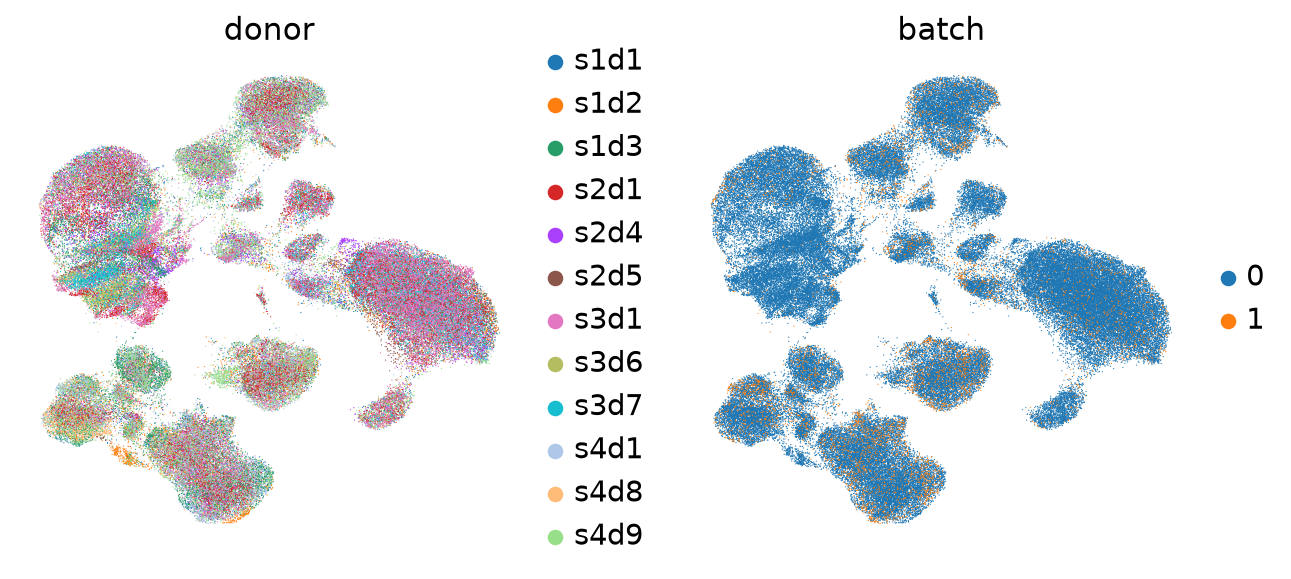
As we can see here, the cells of different donors are much more intermixed in the embedding than before (see plots from the Dimensionality Reduction chapter).
sc.pl.umap(mdata["prot"], color=["CD4-1", "CD8", "CD3"])
sc.pl.umap(mdata["prot"], color=["CD14-1", "CD16"])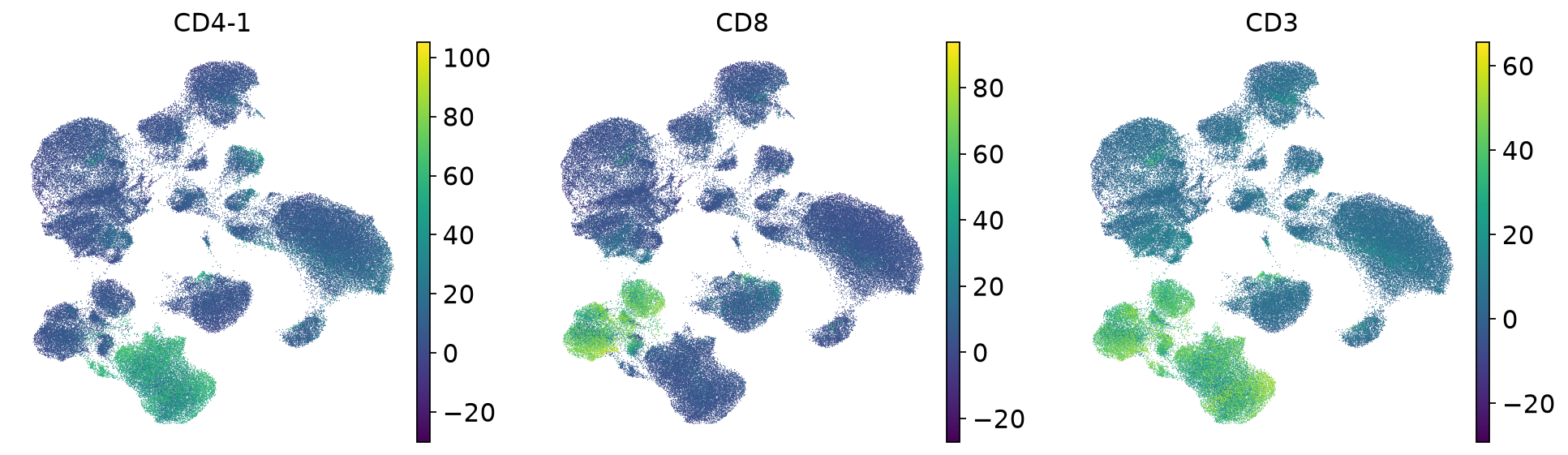
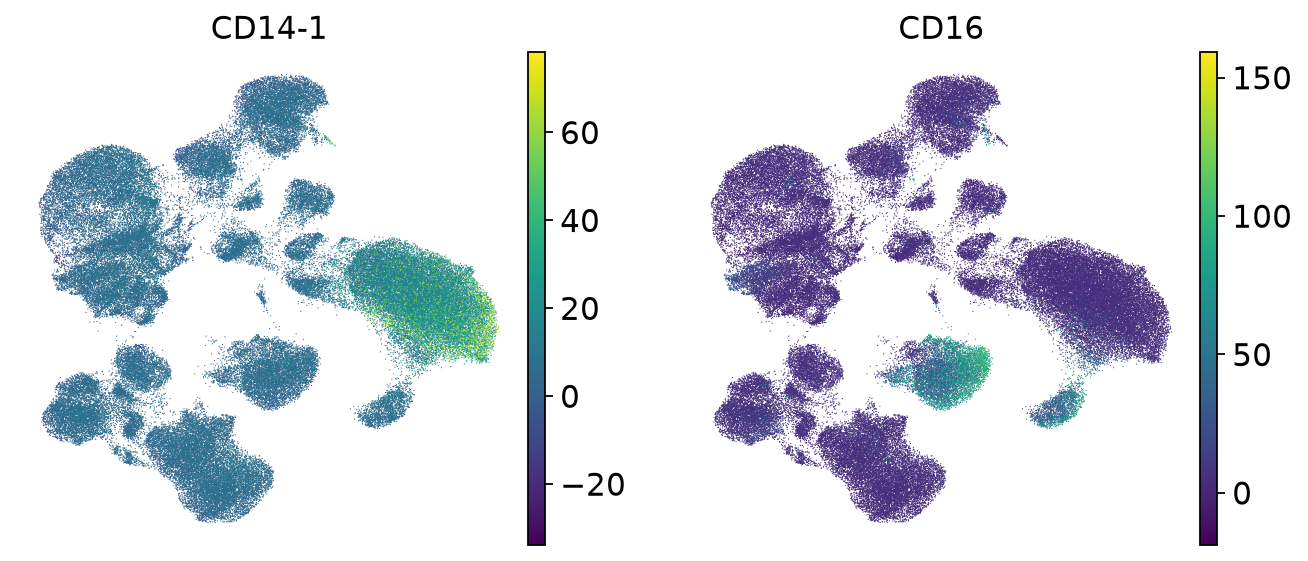
We check the expression of a few marker genes to confirm that separate cell types are still separate from each other. We can see that T cells still form a separate population that is further split into CD4 and CD8 T cells. Additionally, unlike before batch correction, now CD4 T cells form a discrete cluster where the donors are intermingled. Batch correction was therefore successful.
af_batch_correction = ln.Artifact.from_mudata(
    mdata,
    key="surface-protein/cite_batch_correction.h5mu",
    description="CITE-seq data after batch correction",
)
af_batch_correction.save()
Output
→ creating new artifact version for key 'surface-protein/cite_batch_correction.h5mu' in storage 's3://lamin-eu-central-1/VPwcjx3CDAa2'
... uploading uu6lLafald9WnYWL0006.h5mu: 100.0%
• replacing the existing cache path /var/cache/user/marchena/.cache/lamindb/lamin-eu-central-1/VPwcjx3CDAa2/surface-protein/cite_batch_correction.h5mu
Artifact(uid='uu6lLafald9WnYWL0006', key='surface-protein/cite_batch_correction.h5mu', description='CITE-seq data after batch correction', suffix='.h5mu', kind='dataset', otype='MuData', size=1449791144, hash='aYPsyP7ViUyvXh9Ss2YpzB', n_files=None, n_observations=105907, branch_id=1, created_on_id=1, space_id=1, storage_id=1, run_id=114, schema_id=None, created_by_id=7, created_at=2026-07-29 11:15:27 UTC, is_locked=False, version_tag=None, is_latest=True)ln.finish()Output
• please hit CTRL + s to save the notebook in your editor .... still waiting .....
....................! please hit CTRL + s to save the notebook in your editor and re-run finish()
Contributors
We gratefully acknowledge the contributions of:
Authors
Javier Marchena-Hurtado
Daniel Strobl
Ciro Ramírez-Suástegui
Reviewers
Lukas Heumos
Anna Schaar
- Zheng, Y., Caron, D. P., Kim, J. Y., Jun, S.-H., Tian, Y., Mair, F., Stuart, K. D., Sims, P. A., & Gottardo, R. (2025). ADTnorm: robust integration of single-cell protein measurement across CITE-seq datasets. Nature Communications, 16(1), 5852.
- Ingelfinger, F., Levy, N., Ergen, C., Bakulin, A., Becker, A., Boyeau, P., Kim, M., Ditz, D., Dirks, J., Maaskola, J., & others. (2025). CytoVI: Deep generative modeling of antibody-based single cell technologies. bioRxiv, 2025–09.
- Korsunsky, I., Millard, N., Fan, J., Slowikowski, K., Zhang, F., Wei, K., Baglaenko, Y., Brenner, M., Loh, P., & Raychaudhuri, S. (2019). Fast, sensitive and accurate integration of single-cell data with Harmony. Nature Methods, 16(12), 1289–1296. 10.1038/s41592-019-0619-0